
Does a Solidor composite door save money on heating? Learn about U-Values, draft-killing seals, and use our 2026 checklist to buy with confidence.
What You’ll Learn:
- Demystifying how thermal insulation is measured and how upgrading to a premium door can cut your hallway heat loss in half
- Understanding how a 48mm solid timber core retains heat while high-performance compression seals eliminate drafts
- Dispelling the myth that glass panels create cold spots by utilizing advanced Argon-filled double and triple glazing
- Armed with the exact questions to ask and red flags to spot to avoid low-spec “white label” doors
(Estimated Reading Time: 5-6 Minutes)
Introduction
Most homeowners buy a composite door for two reasons: to make their home look better and to make it feel warmer. But while “Energy Efficiency” is a common buzzword, few people understand what actually keeps the heat in—and how to spot a door that’s all style and no substance.
In this final guide, we break down the thermal science of composite doors and provide the exact checklist you need to buy with total confidence.
Thermal Performance: Understanding U-Values
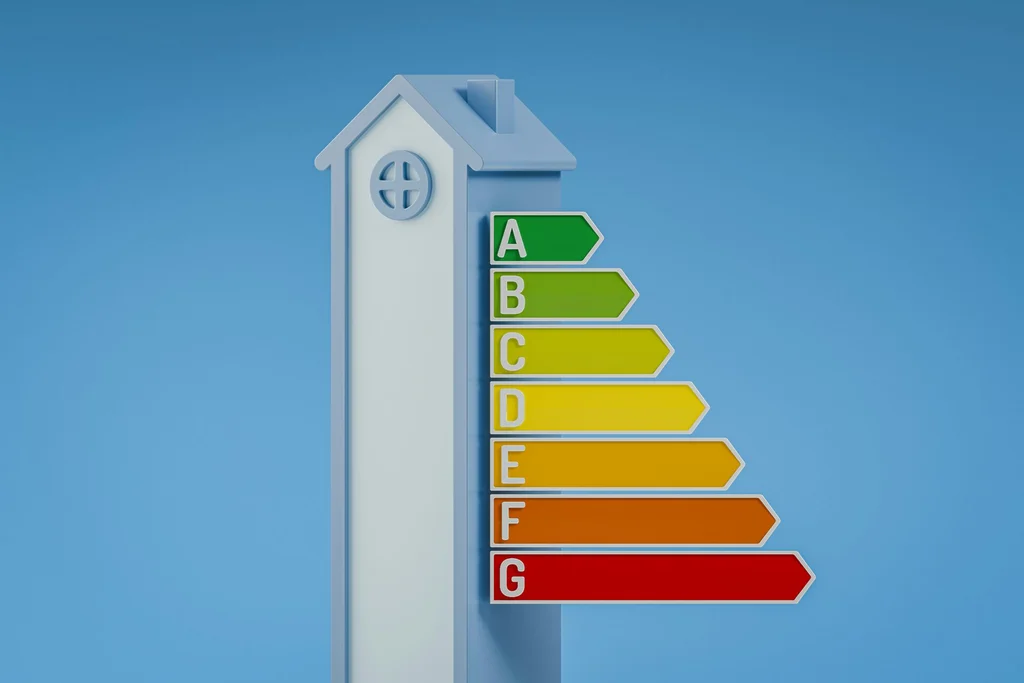
A U-Value measures how effective a material is as an insulator. The lower the number, the less heat escapes.
- The Standard: Most modern composite doors achieve a U-Value of around 1.4 W/m²K.
- The Comparison: An old timber door or an unreinforced uPVC door can have a U-Value as high as 3.0. By upgrading, you are essentially doubling your protection against the cold.
The Draft Killer: Seals vs. Cores
Insulation isn’t just about the thickness of the door; it’s about the “Airtightness.”
- The Core: A 48mm solid timber core (Solidor) provides massive “thermal mass.” It absorbs heat from your home and holds onto it, acting like a storage heater for your hallway.
- The Seals: Energy efficiency fails if the door doesn’t sit tight. Premium doors use high-performance compression seals. When you lift the handle or the AV4 lock engages, it pulls the door slab into the gaskets, creating a vacuum-like seal that kills drafts instantly.
Is Glazing a “Weak Link”?
It’s a common myth that more glass means a colder home.
- Modern Units: We use double or triple-glazed units with Argon gas-filled cavities and “warm edge” spacers. These are designed to reflect heat back into the room.
- The Result: While a solid panel is technically more insulating, a high-spec glazed unit in a Solidor still outperforms a standard solid uPVC door.
The 2026 Buyer’s Checklist
Before you sign a contract or pay a deposit, ask these five “Expert” questions to ensure you are getting a premium product:
- “Is the core solid timber or foam-filled?” (Timber is for longevity; foam is for budget).
- “Is the entire system—door, frame, and hardware—PAS 24 compliant?”
- “Does the cylinder lock have a £5,000 anti-snap guarantee?” (Like the Ultion).
- “Are the glass units internally beaded?” (For security).
- “Who carries out the professional survey and the final adjustment?”
Red Flags: When to Walk Away
- The “Today Only” Price: If a salesperson drops the price by 50% because they “called their manager,” the original price was a scam.
- Vague Specs: If they can’t tell you the thickness of the core or the brand of the lock, it’s likely a low-spec “white label” door.
- External Beading: If the glass can be removed from the outside with a screwdriver, it is not a secure door.
Why Choose Timber Composite Doors?
We believe in Transparent Pricing. Our online designer gives you a 100% accurate price for a high-performance Solidor in seconds. No pressure, no hidden extras, just the UK’s best-engineered door at a fair price.
🛒 Browse online: www.timbercompositedoors.com
📞 Or Call us: 01642 309576 for expert advice
In a rush? Why not contact us via Whatsapp
Browse Our Articles
- Solidor Door Specifications Explained
- Solidor Front Door Colours: Find the Perfect Shade
- Solidor Door Colours: 2026 Trends & Top Picks
- Trade Solidor Composite Doors: looking for trade prices? Visit our trade site, The Trade Village
