Compare Solidor vs uPVC doors and see why upgrading delivers better security, warmth, longevity, and kerb appeal in modern UK homes.
What You’ll Learn:
- How a solid core delivers strength, stability, and everyday confidence.
- Why Solidor resists force and intrusion far better than uPVC doors.
- How Solidor eliminates draughts, cold spots, and outside noise.
- Why Solidor lasts longer and cost less over time.
(Estimated Reading Time: 9-10 Minutes)

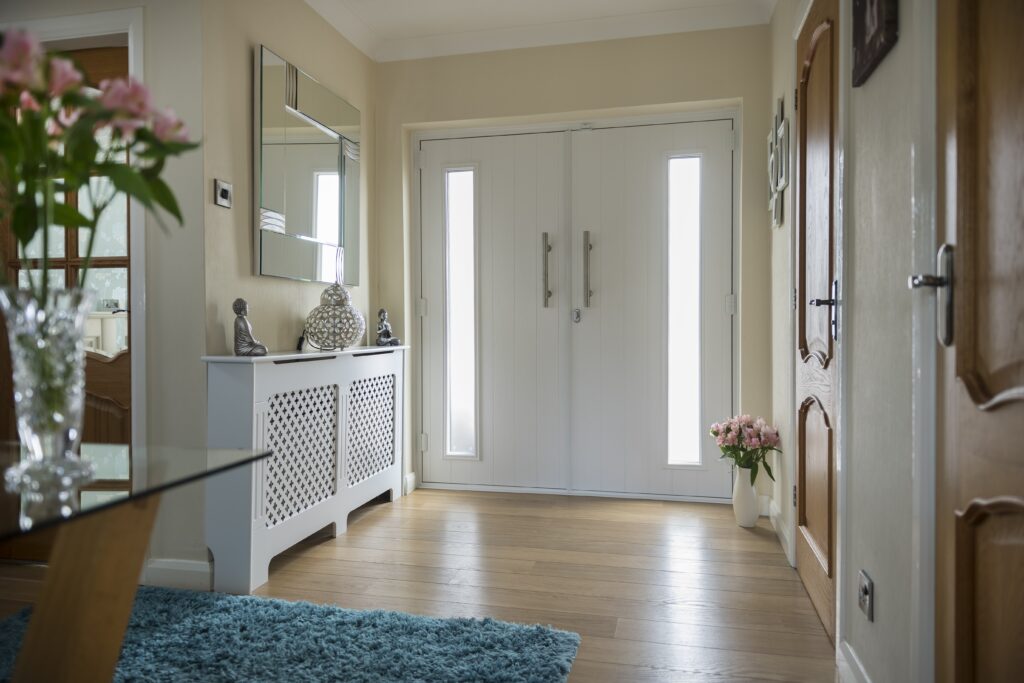
Intro: uPVC solved yesterday’s problems — Solidor solves today’s
uPVC doors were once a huge step forward. They replaced draughty timber, reduced maintenance, and made front doors more affordable for millions of UK homes.
But expectations have changed.
Modern homeowners now demand better security, stronger construction, improved insulation, quieter interiors, and doors that look as good in 20 years as they do on day one. That’s exactly where Solidor composite doors outperform uPVC in every meaningful way.
This guide explains why upgrading from uPVC to Solidor is one of the simplest yet most effective improvements you can make to your home.
1. Core Construction: Hollow vs Solid — and the difference is night and day
Let’s start with the bit that matters most.
uPVC Doors
- Plastic outer frame
- Hollow or polystyrene-filled
- Weak under impact
- Prone to flexing
- Thin internal reinforcement
Solidor Composite Doors
- 48mm engineered solid timber core
- Dense, heavy, rigid, secure
- Zero flex
- Noise-reducing
- Designed to last decades
This is the real difference:
A uPVC door bends when you push it.
A Solidor doesn’t move at all.
You can literally feel the quality the moment you open and close it.
Winner: Solidor by a country mile.
2. Security: uPVC doesn’t stand a chance
The lock is important — but so is the panel strength.
uPVC Door Weaknesses
- Can be kicked in
- Panels can be pushed through
- Reinforcement is minimal
- Prone to twisting under force
- Old-style euro cylinders easily snapped
Police forces across the UK have been warning about outdated uPVC doors for years.
Solidor Advantages
- Uncuttable solid timber core
- Reinforced frame
- Ultion 3-Star Plus anti-snap lock as standard
- Compression-sealed for maximum rigidity
- Zero break-ins recorded through the cylinder in 17 years of our installs
If security matters — and for most people it does — there is no comparison here at all.
Winner: Solidor every time.
3. Thermal Performance: eliminating cold spots for good
Older uPVC doors are notorious for:
- Draughts
- Warped frames
- Shrinking seals
- Poor compression
- Cold transfer
You can usually feel the temperature drop the moment you step into the hallway.
Solidor’s engineered construction and deeper profile solve these issues entirely.
Thermal Comparison
| Door Type | U-Value | Result |
|---|---|---|
| uPVC | 1.8–2.0 W/m²K | Below modern expectations |
| Solidor | 1.4 W/m²K | Warm, efficient, future-proof |
The difference is tangible — especially in winter.
Customers regularly tell us their hallway becomes the warmest part of the house overnight.
Winner: Solidor.
4. Appearance & Kerb Appeal: The look of the home changes instantly
Most uPVC doors look dated — because the designs haven’t changed much since the 90s.
Shallow mouldings, plastic-looking panels, flimsy glazing, and predictable white or woodgrain finishes.
Solidor, by contrast, looks like a premium entrance feature — because it is.
Why Solidor transforms a home visually
- Deep woodgrain texture
- 20+ colours (including matt & heritage shades)
- Dual-colour options
- Designer handles & modern hardware
- Dozens of traditional and contemporary door styles
We’ve seen homes go from “fine” to show-stopping with a single upgrade.
It’s one of the best kerb-appeal investments you can make.
Winner: Solidor, no contest.
5. Longevity: uPVC wears out — Solidor doesn’t
uPVC was never meant to last forever.
The material weakens over time, especially in direct sunlight.
The frame expands and contracts.
The panel fades or discolours.
The hardware corrodes.
The door eventually stops closing properly.
Typical lifespan? 8–12 years.
Solidor?
We have doors from 2008 still performing flawlessly today — that’s nearly two decades of real-world proof.
Solidor lifespan: 20–25+ years
uPVC lifespan: 8–12 years
Buying a Solidor is buying two (sometimes three) uPVC doors’ worth of lifespan upfront.
Winner: Solidor again.
6. Soundproofing: a silent upgrade homeowners instantly notice
Because uPVC doors are lightweight and hollow, they struggle to block outside noise.
Solidor’s heavy timber core massively reduces:
- Traffic noise
- Street noise
- Wind noise
- Neighbour noise
For homes near roads, schools, or busy estates, the difference is huge.
Your home literally sounds quieter.
Winner: Solidor. Not even close.
7. Maintenance: uPVC needs more attention than people think
uPVC doors:
- Expand in summer
- Contract in winter
- Need hinge adjustments
- Suffer from gasket compression
- Lose colour over time
- Often need realignment yearly
Solidor?
A wash with warm water and a 2-minute hinge lubrication twice a year and it just works.
No warping.
No bowing.
No seasonal issues.
Winner: Solidor — engineered stability with minimal effort.
8. Price Comparison: the numbers finally make sense
| Door Type | Typical Installed Price |
|---|---|
| uPVC Door | £600–£1,000 |
| Solidor Fully Fitted | £1,490–£1,750 |
A Solidor is £700–£1,000 more.
But here’s the real question:
Is a door that lasts 2–3 times longer worth 2–3 times the price?
Of course it is.
Especially when it:
- Saves on heating
- Improves security
- Reduces noise
- Boosts kerb appeal
- Increases property value
- Doesn’t need replacing every decade
Winner: Solidor on long-term value by a huge margin.
9. Real Customers Tell the Story Best
“We upgraded from a uPVC door expecting a small difference. The change was enormous. Our hallway is warm for the first time in 15 years.”
– Johnston Family, Newcastle
“Solidor feels like shutting a bank vault. Our old uPVC door used to rattle in the wind.”
– A. Hughes, Milton Keynes
“There’s no comparison. The colour, the weight, the finish — the moment you see it, you know it’s premium.”
– S. Patel, Birmingham
Conclusion: Upgrading from uPVC to Solidor is the simplest, smartest home improvement you can make
If you want:
- better security
- better warmth
- better soundproofing
- better looks
- better lifespan
…you already know which way this comparison goes.
uPVC was fine for the 90s and early 2000s.
Solidor is built for modern living.
And when you buy from Timber Composite Doors, you get the UK’s No.1 Solidor supplier and installer behind every fit.
🛒 Browse online: www.timbercompositedoors.com
📞 Or Call us: 01642 309576 for expert advice
In a rush? Why not contact us via Whatsapp
Browse Our Articles
- What is a Glazed Door and Are They Worth Considering?
- What is a Composite Front Door?
- Are You Looking For a New Front Door?!
- Trade Solidor Composite Doors: looking for trade prices? Visit our trade site, The Trade Village
FAQ’s
Is Solidor more secure than uPVC doors?
Yes. Solidor’s solid construction and high-security locking systems provide far greater resistance to forced entry than traditional uPVC doors.
Will replacing a uPVC door improve insulation?
Absolutely. Homeowners typically notice immediate improvements in warmth and draught reduction after upgrading to a Solidor door.
How long does a Solidor door last compared to uPVC?
Solidor doors commonly last 20–25+ years, while most uPVC doors need replacing after 8–12 years.
Is the upgrade from uPVC to Solidor worth the cost?
For most homeowners, yes. The added security, energy efficiency, noise reduction, and longevity make Solidor a strong long-term investment.

